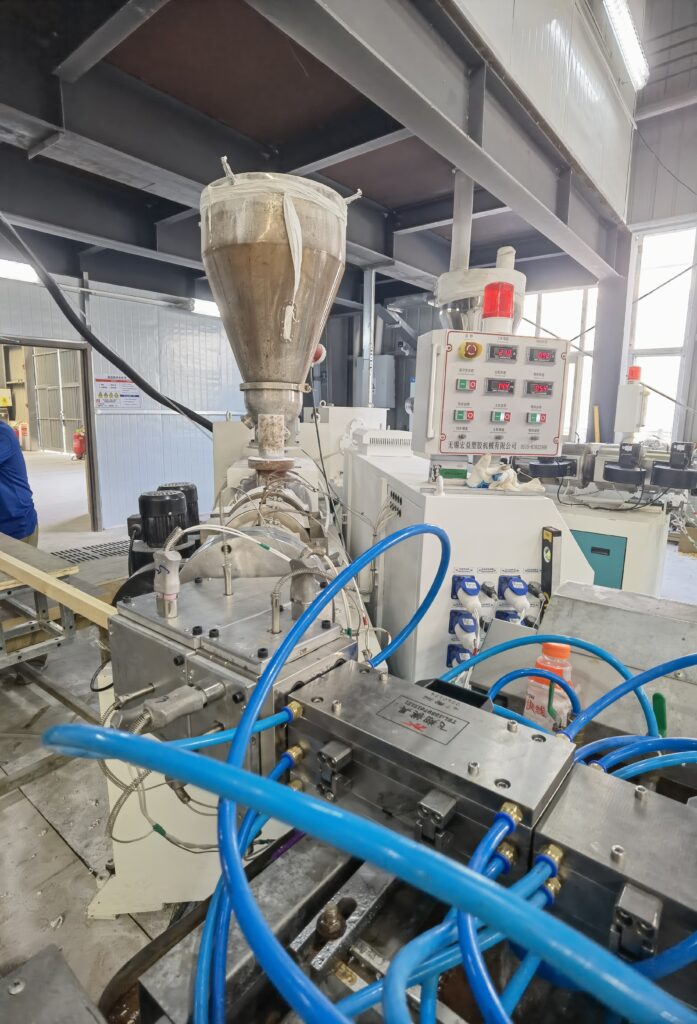
The plastic profile extrusion mold is an important link in the plastic profile molding process. The following figure shows the relationship between each link in the profile production process. The material is supplied to the extruder through the hopper, and the extruder provides the extrusion mold with sufficient flow, excellent reproducibility, and uniform thermal and mechanical properties.

1. Extruder 2. Mold head 3. Shaping mold 4. Cooling water tank 5. Traction machine 6. Cutting saw 7. Turning frame
The extrusion die is composed of a mold head and a shaping mold (also called a shaping device or shaping sleeve). Through the adjustment of the mold head shaping section and the mold lip, the melt is made into a continuous parison with a predetermined cross-sectional shape; through the changes in the geometry and size of the cavity flow channel, the necessary molding pressure is generated to ensure the compactness of the profile. The shaping mold is used to guide the molten semi-finished product and form the necessary shape and size while achieving the specified cooling degree. Other equipment is used to complete the installation of the shaping mold, meet the docking and adjustment of the shaping mold and the mold head, create vacuum adsorption and cooling conditions, and realize continuous production and profile stacking. The entire production process is controlled by the molding process and its parameters. It can be seen that the extrusion mold is a key device in the production of profiles and a hub for achieving docking and coordination of various links. To design a good extrusion mold, it is necessary to understand its working conditions and study its related conditions, namely materials, extrusion production lines, and molding processes.
Whether it is the extrusion process of a single-screw extruder or a twin-screw extruder, it is a complex physical (sometimes even chemical) change process, and there are many factors that affect this process. There are only three goals that need to be met for any extrusion process: the first is to make sure that the extrudate meets a certain output (extrusion volume) goal; the second is to make sure that the quality of the extrudate is met; and the third is to reduce the amount of energy used (or specific power used) while still meeting the first two goals. To achieve these three goals, the key is to stabilize the extrusion process. Although there are many factors that affect the stable extrusion process, they can be summarized into three main aspects, namely material properties— the structure, size, and operating conditions of the screw, barrel, and mold head.
The field trial of the plastic profile extrusion mold is also a complete profile production process. During this period, many problems will occur, and the mold needs to be repaired. However, not all problems are mold -related. It may be a change in the material flow characteristics caused by the chemical formula of the material or the quality of the material, or it may be a problem with the plastic machine. If you repair the mold without figuring out why, you will often damage it. If you master the technology of the molding process, you can adjust the process parameters, make up for some mold defects, and point out the direction of mold repair.
Plastic profile extrusion molds are used to mold polymers whose properties are between Hooke’s solid and Newtonian fluid. Certain temperature and pressure conditions form the plastic parts. To get excellent products, the mold design needs to take into account the different chemical and physical reactions that happen during the molding process, as well as the conditions under which the polymer products need to be molded in order to have certain mechanical properties.
In summary, to study the extrusion mold technology, you must be familiar with its related conditions— that is, the characteristics of the extrusion production line, the characteristics of the material, the characteristics of the mold, and the molding process technology coordinated by the material, the plastic machine, and the mold.